



Read more
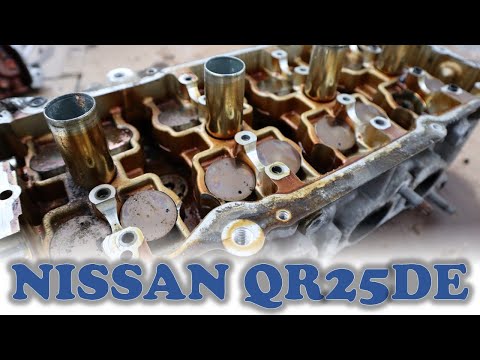
Today I'm going to show you what's inside of the Nissan qr25 engine and how it works this is the common 2.5 liter four-cylinder engine that Nissan has actually been using for more than 20 years this particular one is out of a 2014 Nissan Altima that a drunk guy crashed and totaled the car so this engine is actually a good engine now these engines have had their issues over the years especially in the older models
We're going to tear down and go through everything just to see how it works taking a look around here you can see we've got a plastic valve cover at the top here an aluminium head and an aluminum block your alternator would be here and the AC compressor will be situated here and this would be the front of the vehicle coming around the back here you can see the intake is actually facing the firewall at the back of the vehicle underneath this timing
Cover here there is a timing chain setup and I see three variable valve timing solenoids would be interesting to see what that controls coming around the back side here we do have a plastic intake plenum we got the throttle body over here and this engine only has port injection only with the fuel rail at the top here I'm going to begin this tear down by removing some of these accessories in the way such as this wiring harness just remove these clips
And we'll just go carefully disconnect these cam sensors here all right hopefully I got all the clips and connectors out if I can fish this out of here in order to get the valve cover and timing side up we got to remove this engine mount [Music] next up I'm going to work on the valve cover I need to remove these two PCV hoses
Watch a 10-millimeter volts going all the way around for the valve cover [Music] and that's what it looks like under the valve cover now a typical Nissan fashion valve covers always tend to leak as well as the spark plug tube seals this one isn't even held on by anything on this side and since these are made of plastic they also have a tendency to warp and then you have to replace the whole valve cover taking a look under this engine we
Have dual overhead camshafts with the exhaust side of the front here and the intake side of the back we do have the cam sensors over here which are kind of a weak spot on all Nissans then at the front here we have dual variable valve timing under the timing cover overall it's very simple setup there's no rocker arms or any hydraulic lifters next up we're going to remove the 10 millimeter bolts that'll Hold the top timing cover on
Thank you kind of stinks in here taking a look at the top timing cover you can see there are three variable valve timing solenoids two of them here control the intake which is the one on this side this one here has one line that goes to it and this one here has two galleys that go to it and then this one here only has one variable valve timing solenoid for the exhaust side now taking a look under that top timing cover you
Can see we've got our dual overhead cams and these work with variable valve timing if you want another video on how that works click the link above now here we do have the timing chain and we've also got the timing chain tensioner over here but before I take that off I'm going to try to see if I can crack the crank bolt loose all right I've Jam this breaker bar in here let's see if we can get this crank bolt loose all right that wasn't too bad I'm gonna
See if we can get this crank off of here I'm also going to break the cam bolts loose now I'm going to start removing all the 10-millimeter bolts that hold the timing cover on [Music] there's one thing I hate about a lot of timing setups on engines the fact that in order to remove the timing cover you actually have to remove the lower oil pan first because the bolts go up in
From underneath I'm going to try to remove those bolts and see if you can snake this timing cover off if we can't then we're gonna have to flip the engine upside down before all that we're gonna have to remove this water pump which is thankfully just driven off the serpentine belt external to the engine as opposed to the Nissan vqs where it's inside driven off the timing chain another dipstick out of the way bunch of 12-millimeter bolts
So apparently Nissan uses like a greenish blue coolant so the water pump is actually this front portion over here with the pulley the water pump housing is back here while we're here let's just remove the thermostat housing here's the thermostat next we're going to remove the two 14s that hold the tensioner on plastic belt tensioner now I'm going to remove the 12-millimeter bolts that go into the bottom of the timing cover
Now one thing in general with these hands compared to many other automakers is you tend to use coarser threads on their Fasteners all right there's a couple more 14s that hold this timing cover on look at the amount of sludge on there you can tell some Ultima drivers did not change their oil all right let's see if I got all the bolts out okay maybe there's a bolt under this oil filter and yeah I gotta take out this
Big hex all right so I'm gonna wind this thing out here and there's no bolt hiding back there so we're good so while I can't really get the timing cover off I sure can remove the gears on this side here with the chain I'm gonna remove that variables out from here ow my foot so the timing cover loose and the Cam's out of the way I'm going to remove this intake plenum next so we're going to start by removing
These nuts over here all right let's see if we can pick this off a couple more hoses to disconnect coming around the back to the head here you can see we have a plastic water inlet which I don't like because the crack here the two lines here that go to your CVT cooler slash warmer and we've got the two other lines here that'll go to your throttle body and then at the back here the two lines that goes to your heater
Core and we've got our coolant temp sensor over here we're going to go ahead and unbolt this from the back of the block foreign intake plenum assembly unlike the last engine I tore down Nissan does not give you factory hooks to lift the engine out because they don't expect you to Outlast the vehicle instead the CVT will probably fail first next I'm going to remove the cam sensors these are all 10
Millimeter [Music] so here's one thing I don't like you've got a separate piece here for your cam sensors and a separate piece here at the end for your variable valve timing solenoid and then your valve cover bolts up to between here as well as on these pieces it just makes for multiple interfaces with multiple gaskets which means you have multiple points of failure that could leak it could have
Just made it all into one valve cover like the older cars now for the past 20 years since this engine came out it's always been using port injection that's great because it helps to clean off the intake valves at the back here so you don't have carbon buildup it's only recently that they change over to direct injection on the qr25 engine so go ahead and remove the fuel rail there's always gasoline in there whoa my wife's gonna say I smell like gasoline
But that's what the end of the fuel injector looks like if you want to know a little bit more how fuel injectors work check out my video linked above all right next up I'm going to remove all the 10 millimeter bolts and pull the cam caps on taking a look at the cam bearings you can see that there's a tiny bit of wear over here so being a Nissan Altima I can expect that they probably didn't change their oil very frequently although this
Is just a low mileage engine it's already showing a little bit of wear on the bearing now we just got to pry off these camshafts here oh shoot I was bringing some Force here's one camshaft for the intake holy those cam buckets look purple from here's the other camshaft now the head bolts on this thing are actually pretty tight so I'm going to turn the engine 90 degrees so I can crack them loose on its side
All right not too much mess so the head bolts on these are an e-torx E20 socket dang these are tight [Music] all right I'm gonna gun these off all right now I'm going to remove the head there's nothing much to this block it's just very simple aluminium block with an open deck design we're going to go ahead and flip this over and take off the bottom end
Look at the oil okay we got a big mess of oil here got my wife's nice soft sleeping dress here go ahead and sap that up hopefully it doesn't find out when she sees an oil staying on the driveway all right taking a look at the bottom of the oil pan here you can see these still use a traditional steel oil pan as opposed to plastic or aluminum and wherever this guy crashed his car is probably in the bushes or something and it grazed up the
Oil pan pretty good anyways next up I'm going to remove all the 10 millimeter bolts for this oil pan here [Music] peel off that oil pan there okay it's actually not too sludged up or anything I'm surprised for an Ultima now if you notice the oil pan is actually fairly shallow and most of the oil will actually sit up inside of the engine here that is if the Nissan Altima owner actually tops up their oil and checks it
We do have a plastic pickup tube here so I'm going to go ahead and remove these 10 millimeter bolts you can pick that off I don't see any deposits inside of there so this engine was probably in good shape next we're going to remove all the 12 millimeter bolts going around here that hold the upper oil pan to the block looks like I broke a part of it now I can remove the upper oil pan now the qr25 series of engines use a
Balance shaft in the middle here and that rotates opposite to the crankshaft in order to negate vibrations you can see it's driven off of its own timing chain over here so I'm going to first remove that bolt over here I'm going to go ahead and remove these e-torx E12 bolts that hold the balance shaft to the block wow what is everything's gonna be so tight on this engine
Oh why so tight Nissan's pulling a Volkswagen out of the book here we've got an e-torx E12 on the outside and then there's a weird three spline spoke one on the inside here and then over here you got regular 12 millimeter bolts what's up with that Nissan I'm going to remove the balancer assembly so here we've got the bottom end of this engine it's fairly simple once the
Balance shaft's been removed next I'm going to go ahead and remove this timing cover which I was struggling with in the beginning of this video the reason is because the crankshaft actually has a little recess inside of here where it goes so it has to slide off at the same time as being pried up now taking a look under the timing side of the engine you can see things are fairly simple with a single crankshaft that drives your dual variable valve
Timing gears at the top with its timing belt tensioner where it gets a little bit more interesting is the fact that they've added that valid shaft over here with its own tensioner which is just another point of failure for these but it does make the engine a lot smoother when you have that balance shaft in there I'm going to remove this tensioner here now this is just a standard ratchet style tensioner there's no oil going to
This one I'm going to remove these hex bolts here that hold these plastic guides on typical Nissan fashion the chain guides are actually made of plastic and they could fail after a while like they're doing the v6s all right now we're going to remove this timing chain here you can see it's a quad link timing chain nice and thick as well as the timing chain for the balance shaft that is normal for these connecting rods to have side to
Side play but if it has up and down play shoot this one actually has up and downplay I thought this is a good working engine yeah that might not be good I'm going to zip off these connecting rod bolts they're a 12.10 millimetre socket all right so the rod bearings here actually look okay not too much scoring or any lack of oil or lubrication evidence it's a little bit of minor wear on these bearings indicative of a mid
Mileage engine all right now I'm going to pop the Pistons down and out how much mess it made there's the second pistol third piston and the last piston these Pistons are really oily and my brother always taught me a trick with your shirt or your underwear you always have two sides so you can flip this over and get a nice clean side and then just wipe these down now taking a look at these Pistons you
Can tell this engine has not been maintained in typical Nissan Altima fashion they probably didn't change the oil on time leading to a lot of carbon buildup on top of this engine here you also can see this is the oil control ring over here it is clogged up there is not going to be any oil going through there to the returns at the bottom here and that's what's going to cause oil to build up on the combustion side and this carbon to build up supposedly this was a
Lower mileage engine in terms of the actual piston designs everything seems pretty robust and that's probably why Nissan's been using it for over 20 years now the Pistons are a nice heavy weight it's got a fairly large diameter this being a 2.5 liter four-cylinder engine there are the other two Pistons themselves didn't fare any better you can see they're also full of carbon as well as their oil control rings are all clogged up so that's not going to allow
Oil to flow back and it's just going to burn oil so next up you got to get this cradle out of here and there's a bunch of oil here so I'm going to go ahead and use my brother's old shirt here to sop it up so we can look for those bolt heads buried in here now here's another thing that's a little ancient but also leads to a very robust design Nissan's chosen instead of using bearing caps with just two bolts per bearing cap to hold the crankshaft down to the block
They've instead chosen to use a cradle at the bottom here that encases the entire crankshaft both with your main caps over here as well as some 12 millimeter bolts going all the way around that's great because it's going to increase the structure of the engine overall it could take a lot more power at the bottom end but the only thing being you've got just another interface over here that oil can leak in typical Nissan fashion alrighty the main cap
Bolts are e14e Torx Bolt geez what's up Nissan such tight bolts all right let's run these up all right next let's remove these 12 millimeter bolts all the way around the ladder so actually bolted the engine stand in the wrong spot here against this ladder alrighty now we can lift off this lower ladder frame all right so here we've got the crankshaft rotating assembly I'm going
To go ahead and first remove this crankshaft seal this is actually a Preston design and then I can go ahead and remove the crankshaft all right now I'm going to go ahead and remove this block from the engine stand see we've got all the engine components laid out here let's take a closer look at how this works now we're going to start at the bottom here with the stamped steel oil pan there's nothing much to see here other than they've
Added this extra piece here to the oil pan threads to prevent it from stripping out when you use an impact gun at those quick lube places in the one or two times that the Ultima owner decides to actually change their oil now if there's any oil actually left in that oil pan it's going to make its way to this upper oil pan over here where it's going to get sucked up through the pickup tube in this hole over here also to note that this actually has a small engine mount
Underneath the vehicle that'll prevent rocking motions of the engine and it's actually designed to break off in a collision to send the engine flying underneath the vehicle as opposed to in the driver's lap speaking of the timing chain cover you can see here is where the oil is going to come in the crankshaft is going to rotate allowing fluid to flow it's going to go back out to the oil filter come back in through here and then into the block you can see
Again this engine has a lot of interfaces where Oil Can leak inevitably the timing chain cover is going to be one of them at the end of The Galley on the Block here actually houses the oil pressure answer way up at the top typically they're a little bit further down in the oiling system now as I've mentioned before the ladder frame design that sits at the bottom of the engine is good for strengthening the block and improving reliability while keeping
Things lightweight but it doesn't have any functional purpose when it comes to the lubrication system with the exception of the dipstick hole now taking a look at the Block here you can see here's the entrance from the timing chain cover where that oil is going to come in we have a small oil cooler here which is going to exchange heat with the engine oil coolant and then it's going to send the oil back into the engine through this oil gal see if we can pop
This off here and here you can see that oil cooler oil in and oil out and the same thing over here on the block now oil from the oil cooler is then going to be sent down this main oil Galley which you can see running across the engine over here where it's going to be sent to the crankshaft taking a look down inside of here you can see that that main oil Galley is going to feed these sprayers which are going to line the cylinder walls with oil to lubricate the Pistons
Moving up and down you've also got these holes here on the crankshaft bearings that are drilled down to tap into that oil Galley to feed its some oil additionally I found this dummy sensor over here to warn the ultimate owners when they're out of oil but this is something that typically gets forgotten anyway so what's the point there's also a crank position sensor down here and a knock sensor over here overall Lotus engine is a very standard simplistic
Design very similar to other Japanese and Korean makers in terms of its layout Nissan's actually been perfecting this over the years and some of the problems that have been common with the older models have actually gotten a little bit better although the owners themselves haven't really caught up with that now this engine did not fail and therefore the crankshaft is actually in pretty good shape it's got nice thick journals for the bottom end over here now the
Timing chain uses a one-to-one ratio for driving the camshafts but over here you've got a two to one ratio for the balance shaft so here is the balance shaft assembly this is kind of something I don't really like essentially you've got two shafts over here that have counter balances that rotate in the opposite direction at Double the crankshaft speed in order to counteract vibrations from these larger four-cylinder engines now not all
Four-cylinder engines have balance shafts and therefore I don't really see the point why you would need one of these especially in an unrefined vehicle like a Nissan Altima or a rogue these of course are going to add complexity in terms of their drive for the timing chain side of things as well as weight this thing is considerably very heavy and itself has mass that's moving around inside of it I think it's just something that you could probably do without
Especially if it's not a luxury vehicle like a Mercedes and maybe you could spend the money more on isolating bushings for your engine mounts control arms body mounts as well as sound deadening to make the ride more refined alright next up we come to the engine head here you can see we've got a two layer steel gasket it's kind of grungy though and sort of sludgy not very clean now looking under the head you can see a very simple design with four valves per
Cylinder and the top of the combustion chamber has a sort of v-shape to it here you get the intake Valves and the exhaust valves they're overall in good shape with the exception of a little bit of carbon built up on the intake valves you can see that the Piston has a matching profile over here when it comes up to top dead center to give your compression ratio in addition you've also got this oil feed here for the variable valve time system at the heads
Now the top of this ultimangent you can see we have these valve buckets which are going to provide the interface between the camshaft and the valve stem itself which means that you're going to have to do a valve adjustment on this engine although I don't think the transmission on this car is going to outlast the engine in order to do that taking a look down inside of the intake valves you can see that they are actually pretty clean at the back of the
Valves don't have too much carbon built up on them and you can see exactly where the gas lean which are in these holes over here spray down inside of there to clean them out that's the benefit of having port injection and over on the exhaust side it's worth noting the older versions of the qr25 had issues with the catalytic converter breaking apart and because the exhaust pulses are going back and forth it would actually suck some of that
Particular down inside of the exhaust part and then that would suck it into the engine eventually causing major damage inside of the combustion chamber at the front here you can see the feed that goes to the timing cover for the variable valve timing and look at the amount of sludge inside of here or the timing chain tensioner used to live the timing chain tensioner for the camshafts are actually hydraulically powered and you can see here that these sludges
Building up here either due to a lack of oil changes or someone puts some stop leak in this engine now taking a quick look at the intake you can see we've got a couple of extra stuff on here there's the tumble control valve over here which is going to move a series of valves inside of here to help promote air mix sync when required in addition you've also got these extra flaps over here right where it mounts to the engine head now that is actually controlled by this
Actuator over here and there's a sensor for it over here problem is there are small little screws that hold these flaps on and on older versions of this engine these will actually back out and come loose and then it'd be sucked down into the engine once again causing engine damage now coming around the back here you can see I've got a drive-by-wire throttle body as well as the EVAP service port and the vacuum switching valve for your emissions
Equipment which is going to bring in healthy air from your gas tank and vent it into your air intake and overall you can see the qr25de has got a fairly simplistic four-cylinder design just like many other four cylinders out there although they've made some interesting decisions like the timing cover and the balance shaft inclusion which I think they could improve upon the overall reliability of this engine is pretty much average I wish the same thing could
Be said about their CVT transmissions make sure you subscribe if you want to see more videos and engine teardowns just like this one I think next video we're gonna learn plastic welding to see if I can fix my brother's toothbrush I don't want him to find out that I broke it



0 Reviews
What are your experiences on your vehicle ...